September 15, 2026
Objaverse Alternatives: Why Objaverse Assets Don't Simulate
Objaverse is a library of shapes, not simulation assets. Why they fail in a physics engine, and what Physicl provides instead. Request access
Objaverse is a library of shapes, not simulation assets. Why they fail in a physics engine, and what Physicl provides instead. Request access
Key takeaways
You found Objaverse the way everyone does. It is free, it is enormous, and it installs in one line.
The files open in Blender and look exactly right. Then you load them into a simulator to train a robot, and the scene falls apart. A chair the size of a building. A mug lying on its side. A cup that drops through the table, and a shelf that explodes the first time anything touches it.
Nothing is broken. The files are fine and the simulator is fine. They were built for different jobs, and this is where that shows.
Physicl is the data layer for Physical AI: simulation-ready 3D assets, built for training rather than rendering. The private beta will open soon. Request access and get objects that simulate on arrival.
Objaverse is the largest free collection of 3D models in the world, and it changed what 3D research could attempt. Any honest comparison starts there.
It came out of the Allen Institute for AI in 2022 as a set of 818,000 models made by 160,000 artists, gathered from Sketchfab, where creators had published them under Creative Commons licences. A second release, Objaverse-XL, grew it to around ten million by adding models scraped from GitHub, Thingiverse, Polycam and the Smithsonian's public archive. For scale, the dataset it replaced held fifty thousand.
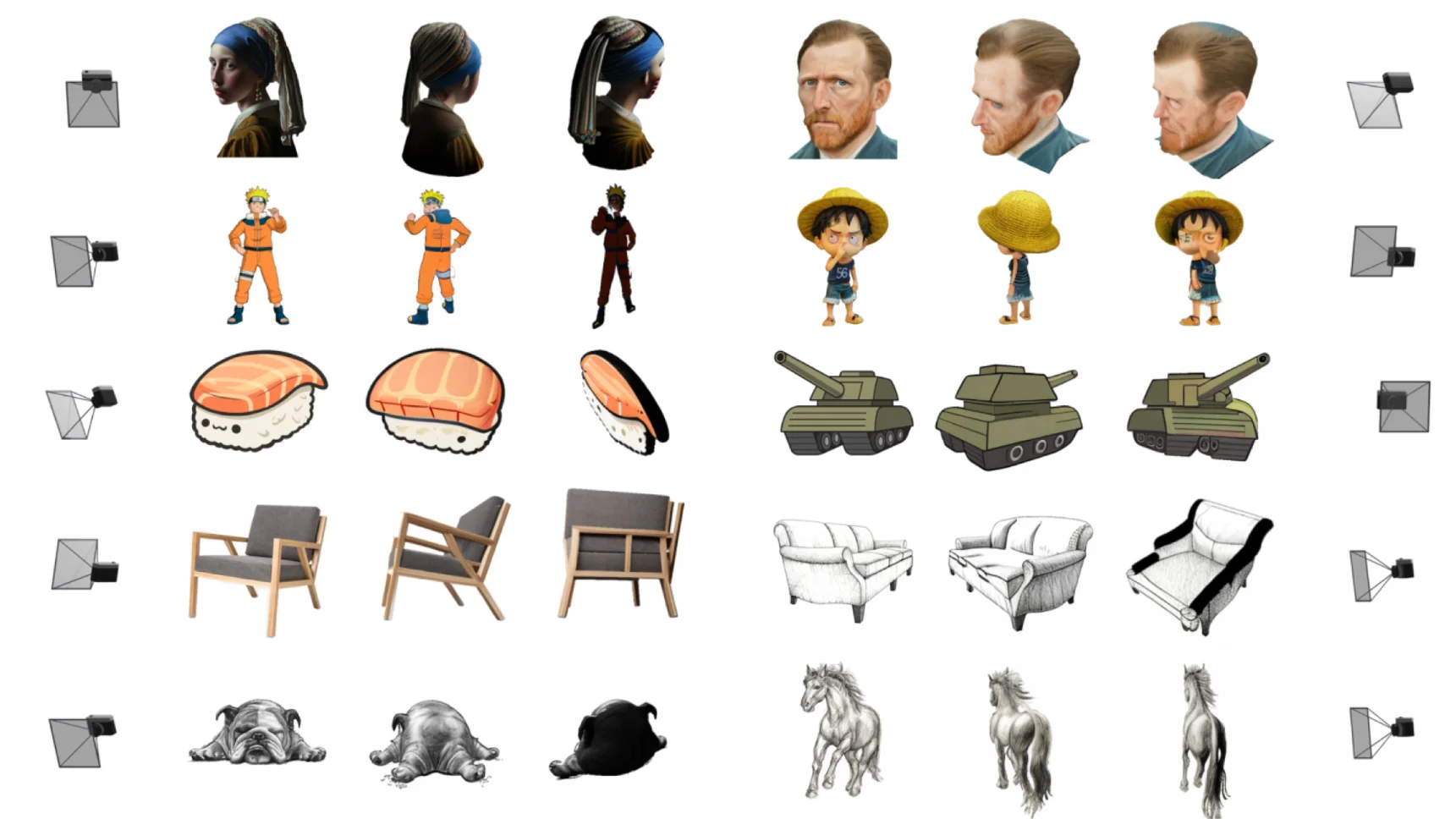
It was built for one purpose: teaching AI to generate 3D shapes. Everything about how it was made points that way. The objects were rendered from random angles and scored on how good the pictures looked. The team's own stated worry, in the paper, is that ten million is still small compared with the image datasets used to train picture generators.
That is exactly the right concern for a shape generator. It is the wrong dataset for a simulator, and its authors never claimed otherwise. The mismatch only shows up when you ask it to do the other job.
A rendering engine asks one question of a file: what does this look like? A physics engine asks a completely different one: what does this do when something pushes it?
The second question needs information the first has no use for, so 3D files built for rendering simply do not store it. That is not a flaw in the format. Nobody rendering a film needs to know how much a chair weighs.
It is worth being specific about what "simulation-ready" means, and the clearest definition is NVIDIA's, because NVIDIA builds Isaac Sim, one of the most widely used robotics simulators. Their SimReady standard sets out what an object must carry before it can be used:
NVIDIA is blunt about what usually turns up instead. Most 3D content arrives without any of it, which makes it "unreliable for physical AI workflows".
A file downloaded from Objaverse carries none of those properties. Here is what that means in practice.
Three pieces of information decide whether a simulated object behaves like a real one.
The dangerous part is that none of this throws an error. With no weight given, a simulator works one out by assuming the object is solid all the way through. With no friction given, it applies a default. The scene runs, the numbers look plausible, and you find out the training was wrong when the robot meets the real object.
Even the Objaverse team ran into this. To use their own models in a simulated house, they had to rebuild collision shapes and cut every mesh down to five thousand vertices first.
There is a simpler problem sitting underneath. The models are not to scale and not consistently oriented, because neither mattered to the artists who made them.
A team building a driving simulator from Objaverse put it plainly: the assets "often have non-metric scales, with examples such as a cucumber being as large as a car". Orientation is the same story. Nothing guarantees the chair faces forward or the mug sits upright, and the file format Objaverse ships in disagrees with most robotics simulators about which direction counts as up.
Neither is hard to fix on one object. Both are weeks of work across a hundred thousand.
The obvious answer is to keep the good files and throw the rest away. Plenty of teams have tried, and they all report much the same thing.
The driving-simulator team above started with 800,000 Objaverse models and kept 158,000. Reaching that figure took ten annotators three weeks just to sort usable from unusable. Adding the physical properties came afterwards. Other teams filtering for simulation report the same pattern: most of the library does not survive, and much of what gets cut isn't even a single object. A separate study that checked a sample of 100,000 found four in ten entries are whole scenes rather than individual things, and a room cannot be picked up.
But the retention rate is not really the point. Filtering is subtraction. You can remove every model that is unusable and you still have not added a single gram of weight, because nobody ever measured it. Whatever survives your filter still needs scale, orientation, collision shapes, mass and friction attached by hand.
And the work does not finish. A filter tuned for street furniture returns nothing useful for a warehouse. Every new environment starts the sorting again. A team that goes this way has not bought a library. It has taken on a permanent job.
There is a second problem that stops commercial deals rather than training runs.
Objaverse is free, but "free" and "yours to use" are different things. The dataset is published under an open licence that covers the list of models, not the models themselves. Each object keeps whatever licence its original creator chose, and the authors say plainly that working out what you are allowed to do with each one is the downloader's job.
For the original release, the published breakdown lists 25,000 objects as NonCommercial, 52,000 as NonCommercial with share-alike, and 16,000 as share-alike alone. The first two groups cannot go into a product you sell. Share-alike can attach conditions to whatever you build from the rest. Those you can at least identify and remove, because the licence is recorded.
The harder problem is the part of Objaverse-XL scraped from GitHub and Thingiverse, which is most of it. Files there were collected by file extension, and no licence analysis has been published for either source. That is a large hole to hand to a legal team, and we have written separately on the rights problem behind training data.
Physicl starts from the other end. Rather than collecting models and filtering toward a standard, every object is built to the standard from the start.
Most of that table is work you could do yourself, given time. Two rows are not, because they have to be captured when the object is built.
That is the difference between generating training data and collecting it.
Physicl is not the only alternative to Objaverse, and it is worth knowing what the others trade away.
The pattern is consistent. You can have scale, or physics, or a clean commercial licence. Nothing free gives you all three, and no amount of filtering adds a property that was never captured in the first place.
This is not a contest between two libraries of shapes. On shapes, Objaverse wins easily, and if you are training something to generate 3D models, use it.
The real question is whether you want to spend the next year building the missing layer yourself. Physical AI is held back by data, not models. Objaverse proved that 3D content can be gathered at enormous scale. The unsolved part is describing it accurately enough for a physics engine to act on. That is infrastructure. It should be built once, not rebuilt by every robotics team in turn.
Request access to the Private Beta, or talk to us about a simulation-ready library for your environment.