Training data for
robot policies.
Studio renders the kinds of building your robot works in, then renders them again with the layout, the light or the camera moved. Every frame carries the geometry it was drawn from.
Most of the buildings a robot will enter were never in its training set.
Studio generates those interiors and reads the geometry off the scene as it draws each frame, so a planner works from the scene itself.
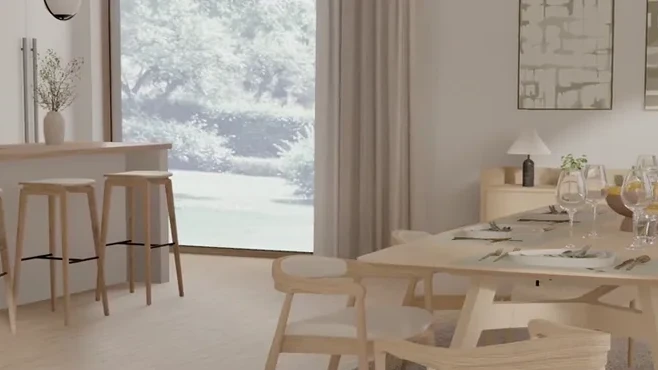
Put them in the
training set first.
Warehouses and depots, hospitals and shops, labs, schools and offices. Each one is a Studio scene you can run again on any axis.
One kitchen, three robots,
three sets of eyes.
A floor robot, a quadruped and a humanoid see the same room from different heights. Studio runs the same path through it at each robot's camera height.
Three jobs a policy team runs.
Each of these takes the frames and the geometry written alongside them. One run can feed several at once, and the axes it turned are recorded with it.
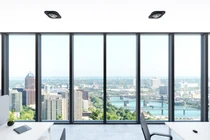
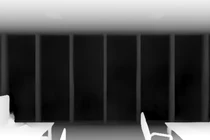
Visual navigation
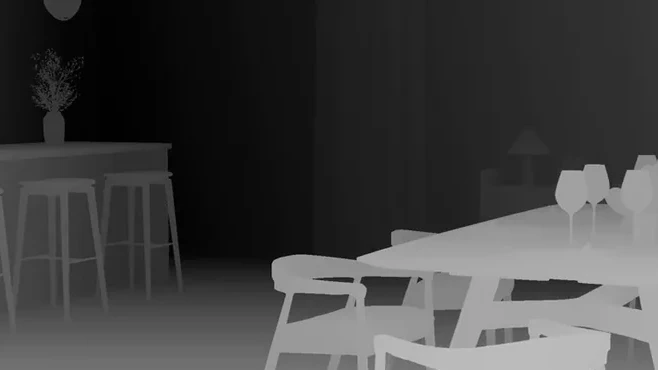
Floors to drive through, with metric depth and camera pose on every frame of the path.
Depth · Camera pose · Beauty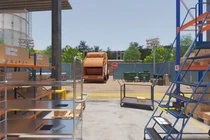
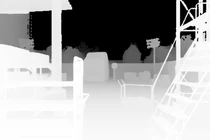
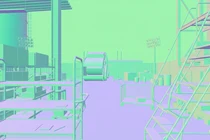
Obstacle and clearance perception
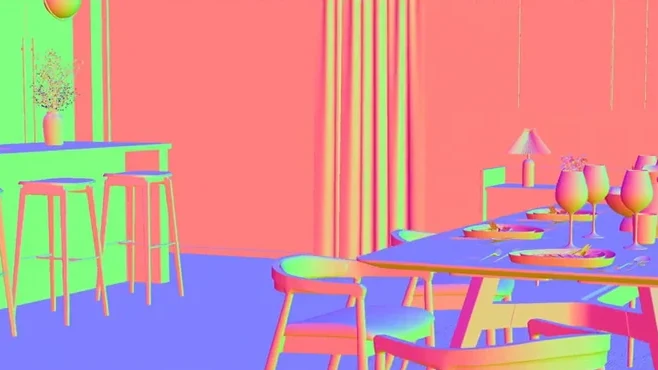
Thin legs, low shelves and glass, the geometry a depth model has to get right before a planner can trust it.
Depth · Normals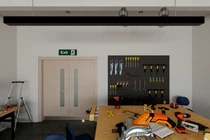
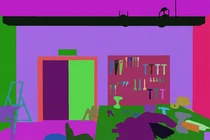
Manipulation target grounding
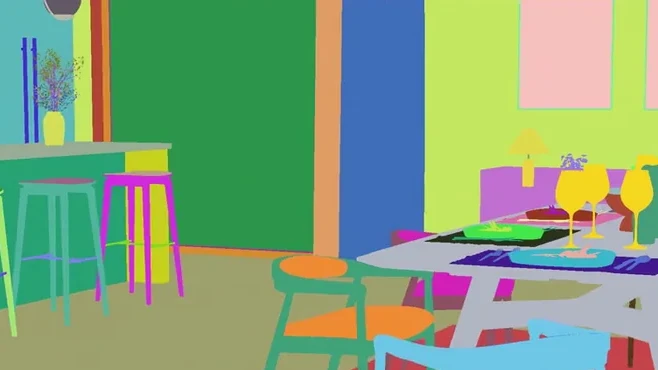
Every object in the room carries its own instance ID, so a grasp target can be named and scored object by object.
Segmentation · Instance IDs · BoxesSee where your policy fails
before your robot does.
Studio is open to a small group of researchers and design partners.
Synthetic data and robot policies.
Does synthetic training data transfer to a real robot?
For indoor visual navigation, yes. A 2025 study found a policy trained in simulation outperformed the same policy trained on real data by 31 points of success rate, with pretrained image encoders mattering more than photorealism.
What is the sim-to-real gap, and how do you measure it?
The sim-to-real gap is the drop in performance when a model trained on rendered data meets the real world, and you can measure it directly. Score the same model on both, then move one axis at a time to find which factor the gap tracks. Every Studio run records the axes it turned, so the comparison holds up months later.
What training data do robot perception models need?
Frames from inside the buildings the robot is sent into, with the geometry attached per pixel: depth in metres for obstacle distance, surface normals for thin structures and glass, and instance masks so a missed object can be named. Camera pose comes with every frame.
Can Physicl Studio train my robot policy?
No. Studio produces the frames and the per-pixel geometry underneath them; it does not train. The training loop, the reward and the rollouts stay in your stack, where they are tuned to your embodiment and your objective.
Does this replace collecting data in the real world?
No. Rendered runs cover the arrangements you cannot stage and the labels you cannot draw by hand. Real capture tells you what your building looks like, and it stays the final check.
What arrives at the end of a run?
One folder per run in the bucket you connected: the frames, the layers beside them, the camera for each frame, and a record of which axes were turned and to what. Nothing is written afterwards by a model, so nothing has to be trusted.
What if the space my robot works in is not in the catalogue?
Say so in your access request, with the space your robot works in.
How do I know the data is any good before I commit?
You generate it yourself. Studio is in private beta, and access means you generate the scene, render it and score the frames on your own benchmark before anything else is decided.